Featured DIN Rail Transfer Switches & Protection Devices
Certified low-voltage switchgear engineered for unstable grid environments, generator integration, and residential solar microgrids.

Executive Summary: Navigating Power Grid Dynamics in Yangon, Myanmar
The Yangon metropolitan region—the commercial epicenter of Myanmar encompassing major industrial parks such as Hlaingthaya, Mingaladon, and the Thilawa Special Economic Zone (SEZ)—operates under severe grid volatility. Managed by the Yangon Electricity Supply Corporation (YESC), the local electrical grid undergoes scheduled and unscheduled load-shedding cycles, frequency fluctuations, voltage sags, and severe transient surges, particularly during the monsoon transition months. For industrial plants, commercial real estate, telecommunications towers, and residential complexes, maintaining continuous power supply is not merely an operational convenience; it is a critical safety and financial imperative.
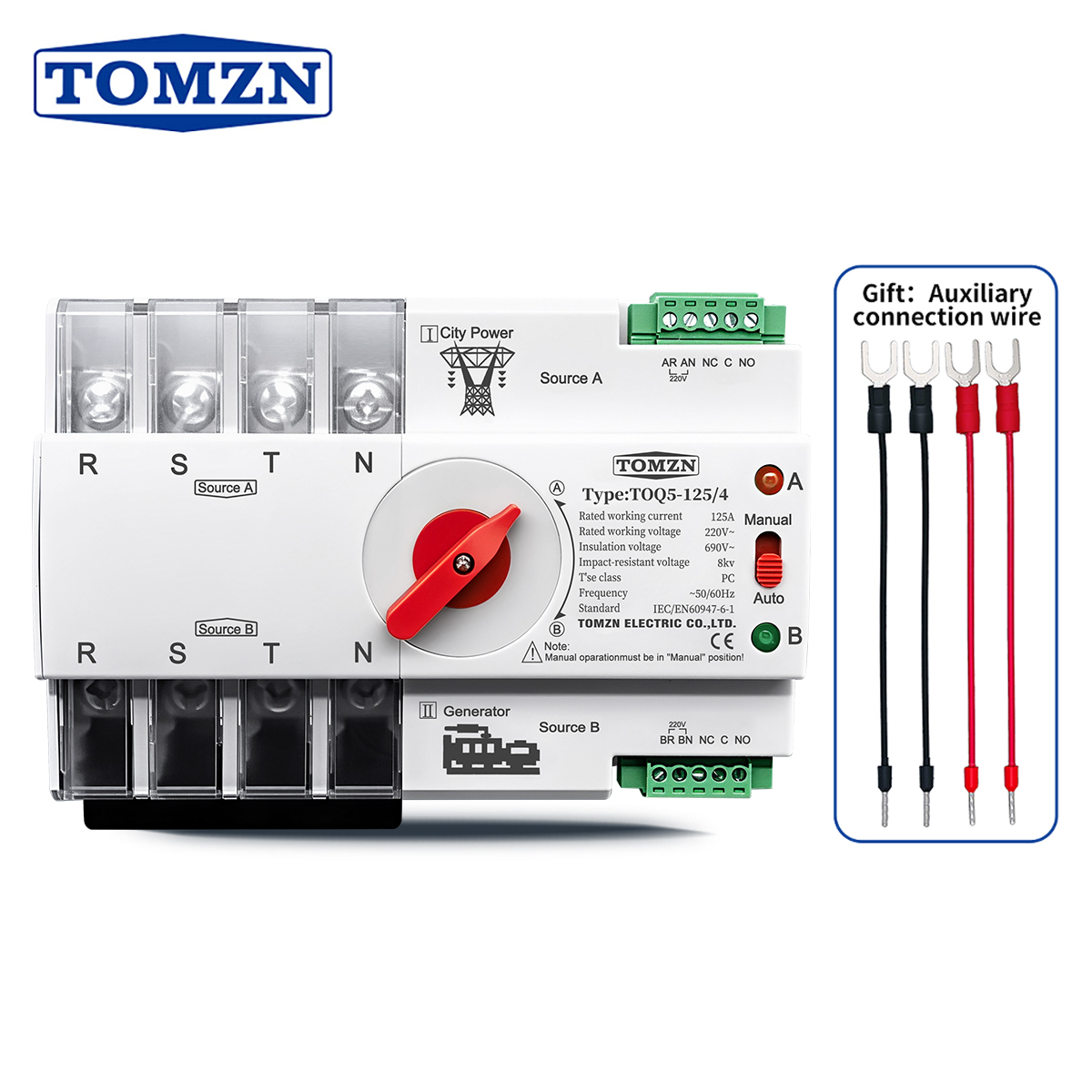
To mitigate grid deficits, electrical contractors and system integrators across Yangon overwhelmingly deploy dual-power redundant architecture. This framework relies on a primary grid supply paired with a secondary backup source, typically a diesel generator set, a hybrid solar photovoltaic (PV) inverter system, or an energy storage system (ESS). The pivotal component within this architecture is the DIN Rail Dual Power Automatic Transfer Switch (ATS). Positioned inside distribution boards, the DIN rail ATS handles real-time voltage monitoring and automated load switching between main power (Source A) and auxiliary power (Source B) without requiring manual intervention.
As a lead China DIN Rail Transfer Switch OEM manufacturer with 24 years of low-voltage production experience in Wenzhou, Zhejiang DVS Electric Co., Ltd. (TOMZN) engineers high-performance modular switchgear tailored specifically to the environmental, voltage, and operational parameters of the Yangon market. This technical whitepaper analyzes the engineering design, insulation compliance, switching speeds, localized application scenarios, and B2B procurement strategies for selecting China-manufactured DIN rail transfer switches serving Myanmar's rapidly evolving power ecosystem.
Technical Architecture of DIN Rail Automatic Transfer Switches
A DIN rail automatic transfer switch is an electromechanical or electronic switching device designed to automatically shift load circuits from a normal power source to an emergency source upon detection of voltage failure, phase loss, under-voltage, or over-voltage anomalies. Understanding the mechanical and electrical construction of these switches is essential for engineering procurement teams in Yangon.
1. Switching Mechanisms: PC Class vs. CB Class ATS
In low-voltage power system design (IEC 60947-6-1 standard), transfer switches are categorized into PC Class and CB Class architectures:
- PC Class ATS: Capable of making and withstand, but not intended for breaking short-circuit currents. PC class switches utilize high-durability contact sets driven by a double-acting solenoid or motor mechanism. They offer superior mechanical endurance (up to 10,000 switching operations) and exceptionally fast transfer speeds (often under 50ms). They rely on upstream Miniature Circuit Breakers (MCBs) or fuses for overcurrent protection.
- CB Class ATS: Equipped with built-in thermal-magnetic trip units (derived from twin MCBs linked by a mechanical interlock). CB class units provide dual functionality: automated transfer and short-circuit/overload protection within a single chassis.
For the Yangon market, where rapid load restoration is necessary to prevent sensitive commercial equipment or inverter systems from tripping, PC-Class and miniaturized dual-MCB CB-Class DIN rail switches represent the optimal solution for distribution boards rated from 16A up to 125A.
Silver Alloy Contact Structure
Utilizes AgCdO or AgSnO2 heavy-duty contacts providing minimal contact resistance, zero welding during high-inrush switching, and extended electrical lifespan exceeding 8,000 continuous cycles under AC-33iB duty.
Mechanical & Electrical Interlocking
Features fail-safe dual interlocks preventing simultaneous connection of Source A (Grid) and Source B (Generator/Inverter), eliminating hazardous backfeeding into the YESC municipal utility grid.
Smart IoT & Wireless Telemetry
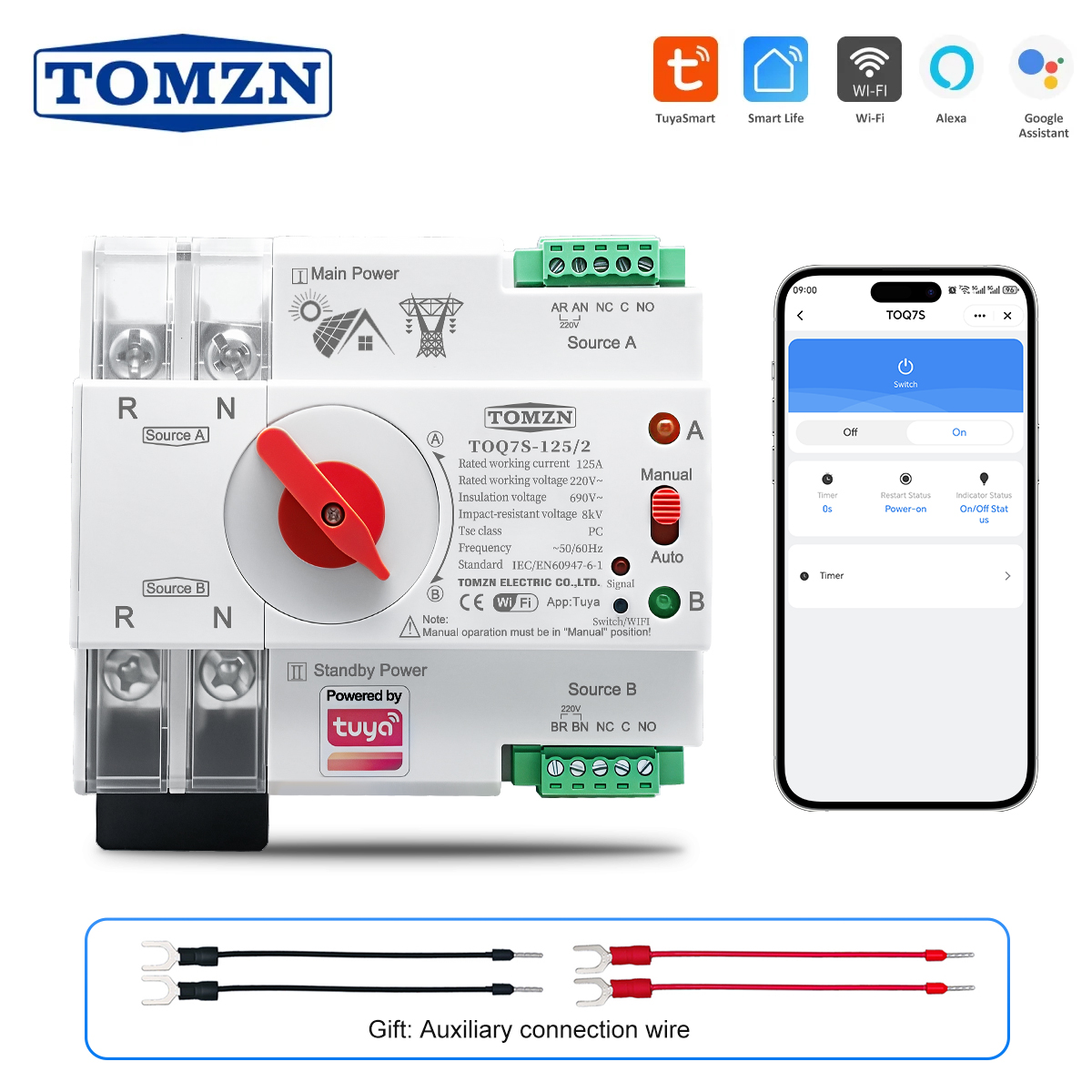
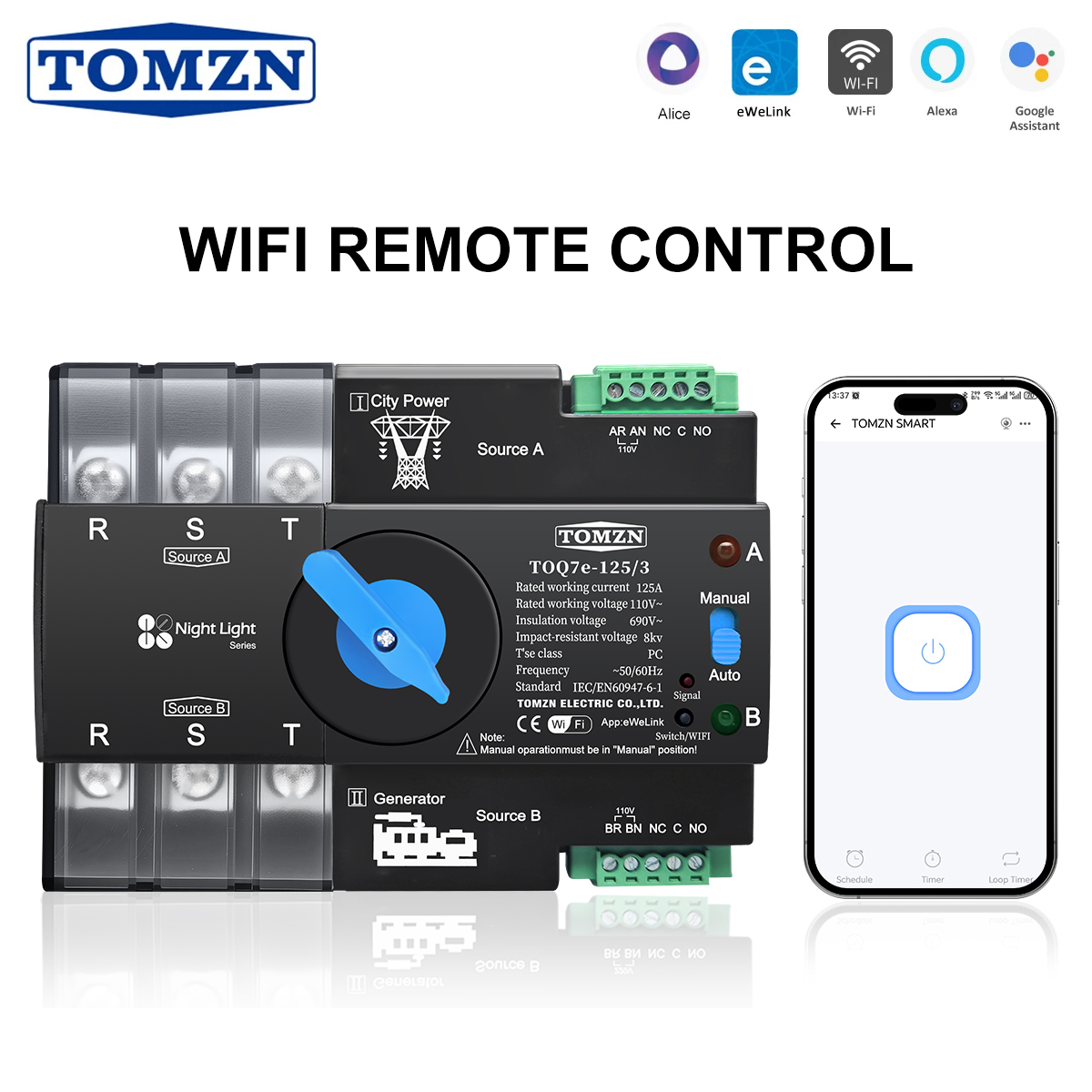
Integrated Tuya/Smart Life and eWeLink WiFi chips allow Yangon property managers to remotely monitor grid status, manually trigger transfer, and track energy usage via mobile devices.
2. Voltage Tolerances & Dielectric Insulation Strengths
The standard low-voltage network in Yangon operates at single-phase 230V AC (±10%) and three-phase 400V AC at 50Hz. However, grid voltage in suburban areas like North Dagon or South Pyay Road can surge beyond 270V during low-demand midnight hours or collapse below 160V during peak afternoon heatwaves. A robust DIN rail ATS designed for China-to-Myanmar export must feature expanded coil operating ranges (80% to 120% Un) and high impulse withstand voltage (Uimp ≥ 4kV) to survive transient lightning spikes common in tropical climates.
Localized Application Scenarios in Yangon's Power Ecosystem
Selecting the correct transfer switch requires matching device specifications with the operational dynamics of specific Yangon installation environments.
Residential Solar-Grid-Generator Hybrid Systems
In residential areas such as Kamayut, Bahan, and Yankin, home owners heavily rely on solar hybrid inverters paired with lithium battery banks and backup diesel generators. Installing a 2P 63A or 100A DIN rail ATS (e.g., TOMZN TOQ3 series) downstream of the inverter allows seamless switching between solar-stored energy and the YESC grid, preserving battery depth of discharge during multi-hour blackouts.
Hlaingthaya & Mingaladon Industrial Zone Workshops
Manufacturing facilities operating sensitive CNC tooling, plastic injection molding, and garment packaging lines cannot endure phase imbalances or dropouts. 4P 125A 3-Phase DIN Rail Transfer Switches deployed in distribution sub-panels guarantee immediate changeover to secondary factory generators, minimizing expensive machine downtime and material waste.
Commercial Office Buildings & Telecom Infrastructure
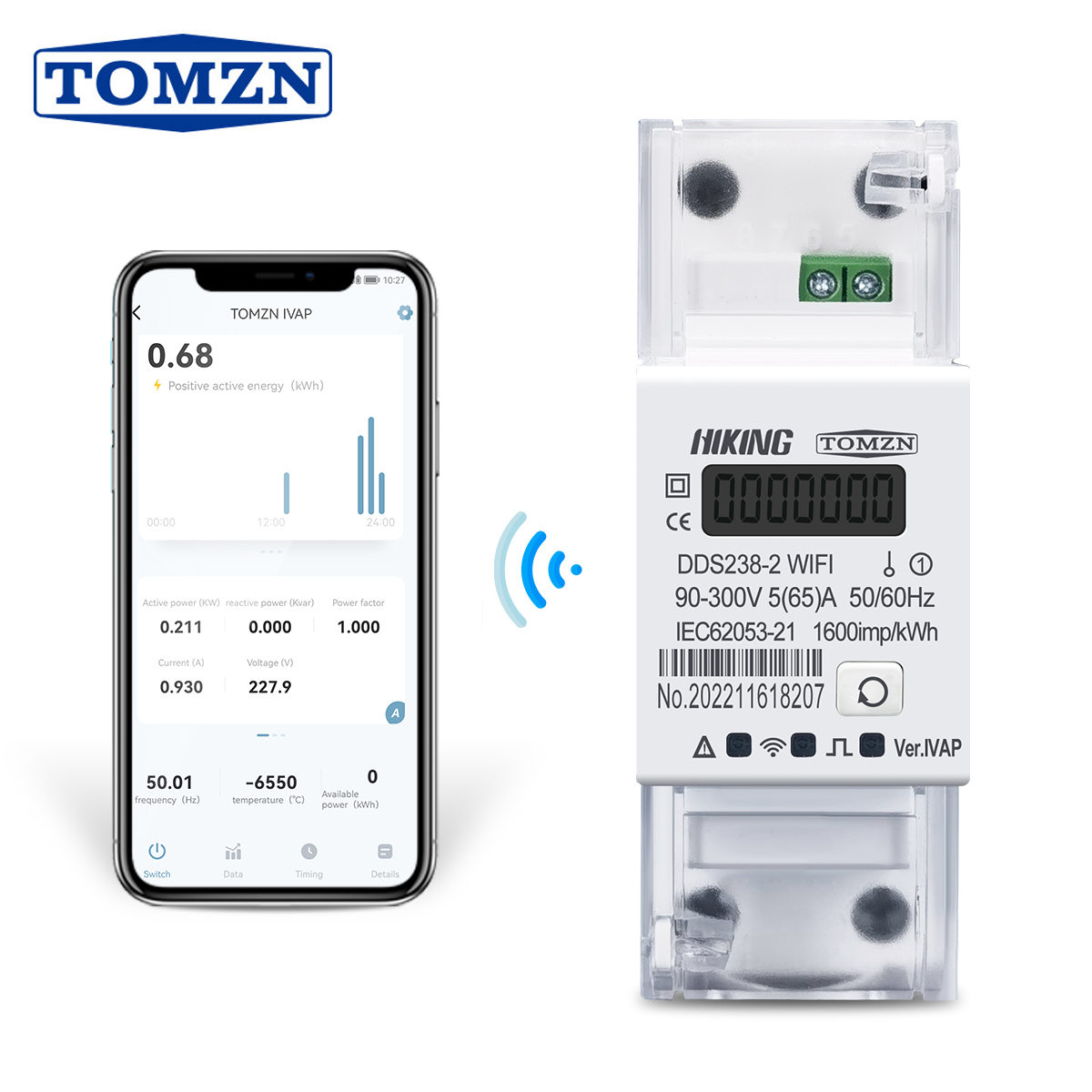
Cellular base stations and commercial bank branches across Yangon require zero-downtime power management. Smart IoT-enabled ATS switches integrated with adjustable voltage relays allow network engineers to monitor phase voltages remotely, execute manual power cycles, and automatically isolate unstable utility supply lines before equipment damage occurs.
Monsoon Lightning Surge & Grid Distortion Mitigation
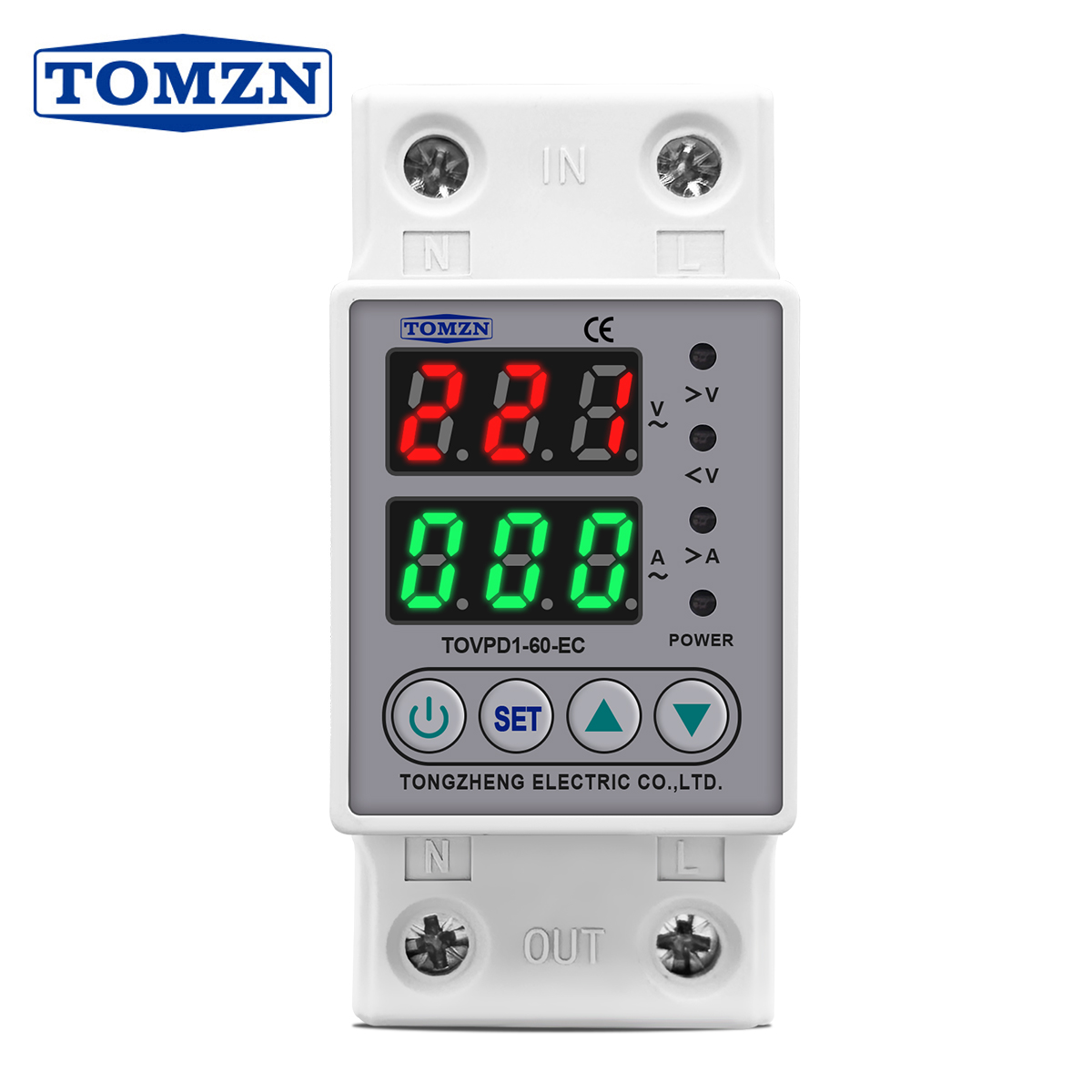
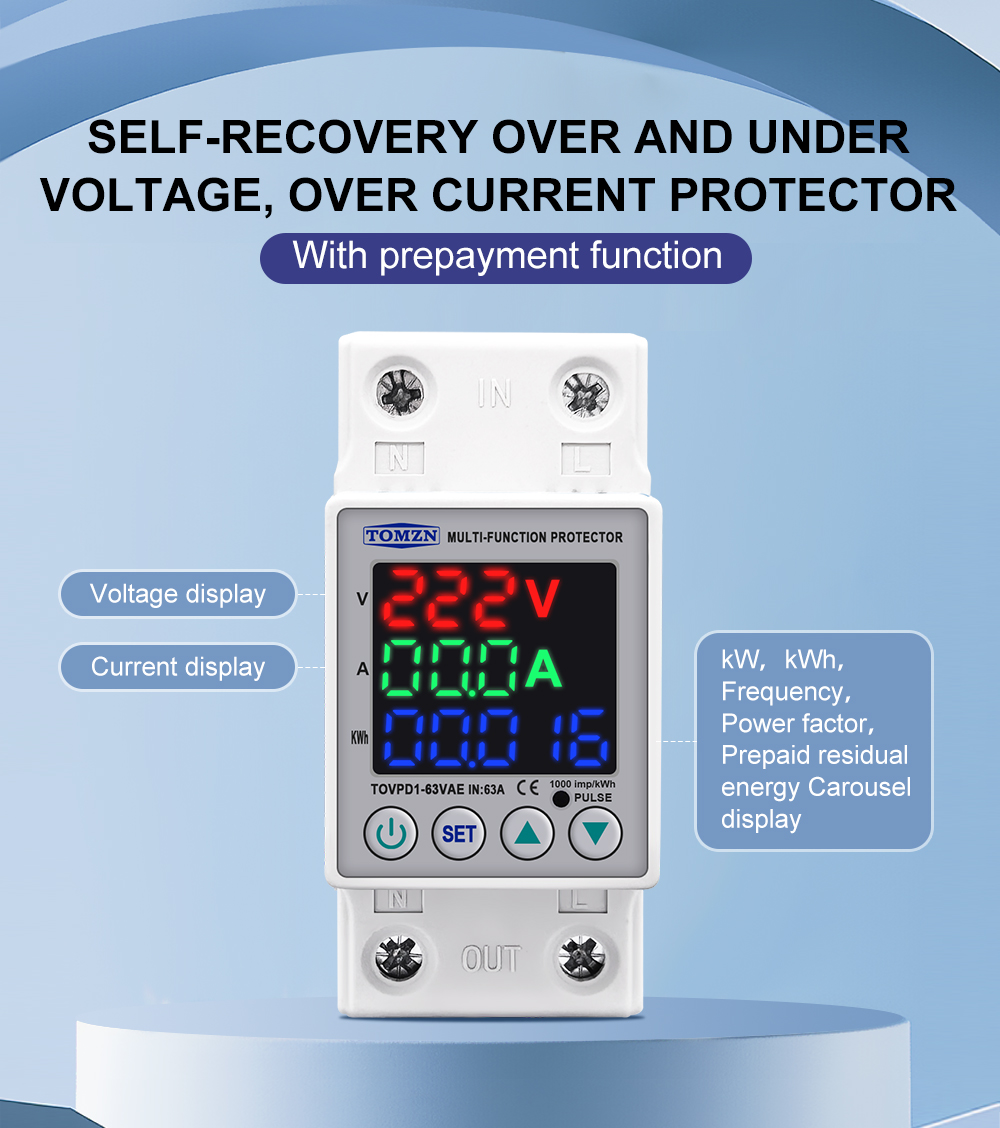
Yangon experiences torrential rain and severe atmospheric lightning during the South-West monsoon season (May to October). Pairing DIN rail ATS switchgear with Type 2 AC Surge Protective Devices (SPDs) and Over/Under Voltage Protectors forms a triple-layer defense shield inside DB boards against indirect lightning strikes and voltage swells.
Comprehensive Product Selection Matrix for Yangon Importers
To assist Yangon electrical engineers, MEP contractors, and wholesale importers in selecting the exact switchgear model for their distribution boards, the technical matrix below details key electrical parameters for our standard DIN rail export lines.
| Model Series | Pole Configuration | Rated Current (In) | Rated Voltage (Ue) | Transfer Time | Key Operational Feature |
|---|---|---|---|---|---|
| TOMZN TOQ3-63/2P | 2P (Single Phase) | 16A, 32A, 63A | AC 220V / 230V 50Hz | < 50 ms | Compact 35mm DIN mount, MCB interlock driving structure |
| TOMZN TOQ3-125/4P | 4P (Three Phase + N) | 63A, 100A, 125A | AC 400V 50Hz/60Hz | < 50 ms | High-capacity 3-phase switching for industrial sub-panels |
| TOMZN Smart Tuya WiFi ATS | 2P / 4P Options | 63A – 125A | AC 110V - 230V | < 40 ms | Remote smartphone control, real-time voltage monitoring, automated timers |
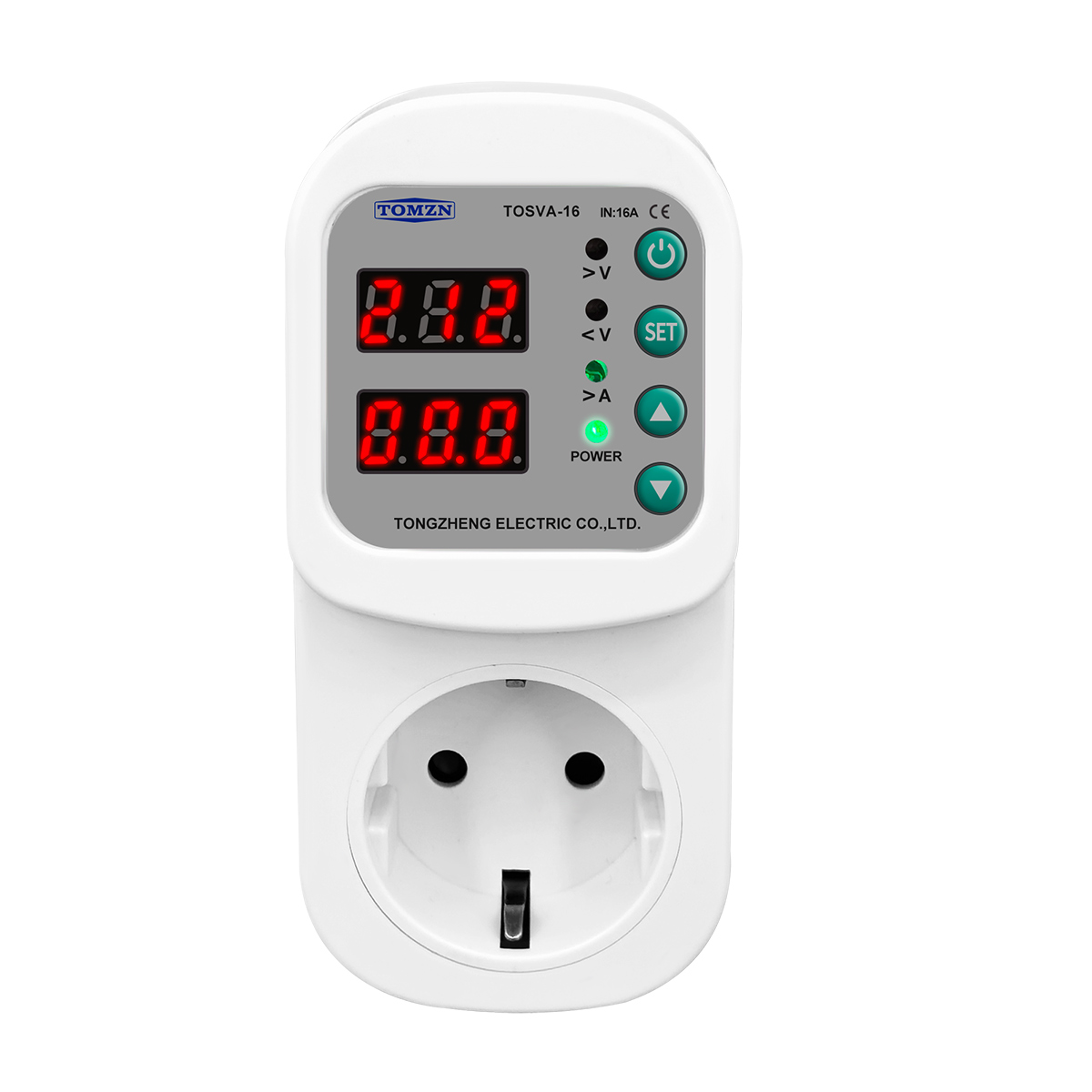
| TOMZN TOSVA Voltage Protector | 1P+N / Socket | 16A – 63A | AC 230V (80V-300V adj.) | < 0.1 s Trip | Self-resetting over/under voltage & overcurrent protection relay |
| TOMZN Smart eWeLink 3-Phase ATS | 3P / 4P | 100A – 125A | AC 110V / 220V / 400V | < 50 ms | Industrial IoT telemetry compatible with automated generator auto-start logic |
Why China Factories Are the Dominant Supply Source for Yangon's ATS Market
China produces over 85% of the world's low-voltage electrical components, with Wenzhou (specifically Liushi Town) recognized globally as the undisputed "Capital of Electrical Appliances". For importers, B2B distributors, and engineering firms in Yangon, sourcing direct from established China DIN rail transfer switch factories offers substantial strategic advantages:
- Unmatched Cost-to-Performance Ratio: Direct factory manufacturing eliminates trading intermediary markups, providing high-grade silver-contact transfer switches at prices aligned with the budgetary realities of Myanmar's infrastructure projects.
- Full OEM/ODM Customization Capabilities: China factories offer complete custom engineering, including bespoke voltage coil windings (e.g., customized 110V/220V wide tolerance coils), custom current thresholds, custom housing mold colors, private-label laser etching, and multi-lingual instruction manuals in English and Burmese.
- Rigorous Quality Control & Testing Infrastructure: Modern factories like Zhejiang DVS Electric operate computerized automated testing lines verifying dielectric insulation, temperature rise under 100% rated continuous current, contact resistance, and transfer time accuracy prior to export packing.
- Streamlined Logistics to Yangon Port: Wenzhou's proximity to Ningbo and Shanghai maritime ports enables rapid containerized shipping (FCL/LCL) to Yangon Port (Asia World Port Terminal / Myanmar Industrial Port), with average transit times ranging from 12 to 18 days.
Zhejiang DVS Electric Co., Ltd. — Your Trusted Manufacturing Partner
With 24 years of manufacturing excellence in Liushi Town, Wenzhou, Zhejiang DVS Electric Co., Ltd. operates a state-of-the-art 5,700 m² production facility certified under ISO9001 quality management systems. Our product portfolio spans DC MCBs up to 1000V, PV combiner boxes, automatic transfer switches, AC/DC SPDs, and smart energy monitoring meters.
Third-Party Verified
Onsite factory inspection and production line verification audited by independent global testing organizations.
CE Compliant
Full CE certification across circuit breakers, ATS units, voltage relays, and surge protectors for export safety.
Flexible MOQs
Standard catalogue stock available from 5 units for sample evaluation, with scalable volume pricing for container orders.
Direct OEM Support
Dedicated technical engineering team supporting custom switchgear specifications, private label branding, and panel integration.
Installation & Engineering Wiring Guidelines for Yangon Technicians
To ensure safe installation of DIN Rail Automatic Transfer Switches in Yangon distribution boxes, electrical contractors should adhere to strict wiring protocols:
Follow these steps during panel assembly:
- Upstream Overcurrent Protection: Install correctly sized Miniature Circuit Breakers (MCBs) or Fuses upstream of both Source A and Source B terminals to protect the ATS against short-circuit currents exceeding its rated short-time withstand capacity (Icw).
- Neutral Line Wiring in 4P Systems: In Yangon's TN-S or TN-C-S earthing configurations, 4-Pole ATS units must be utilized to switch both phase lines and the neutral line simultaneously, preventing stray neutral earth currents during generator operation.
- Generator Auto-Start Signal Linkage: Utilize the auxiliary signal dry-contacts on the ATS control terminal to send a start-signal to the diesel generator's automatic mains failure (AMF) controller upon grid blackout.
Frequently Asked Questions (FAQ) for Yangon B2B Buyers
Here are authoritative engineering and commercial answers to common questions raised by electrical equipment importers and contractors in Myanmar.
